In machine vision, capturing every detail matters. As industries constantly push for greater precision, engineers must rely on ultra-high resolution cameras to keep throughput up, while keeping complexity and costs down. To keep up with the ever increasing demands, developers have turned to pixel shift technology- a key innovation used to significantly increase a camera’s resolution.
Pixel shifting works by physically moving a camera’s sensor. In four shot mode, the sensor shifts in 4 ½ pixel increments in the xy plane, producing four images that are combined into one singular image. The result is an image with four times the resolution of the initial capture. In nine shot mode, the sensor shifts in 9 ⅓ pixel increments, resulting in an image with nine times the resolution.
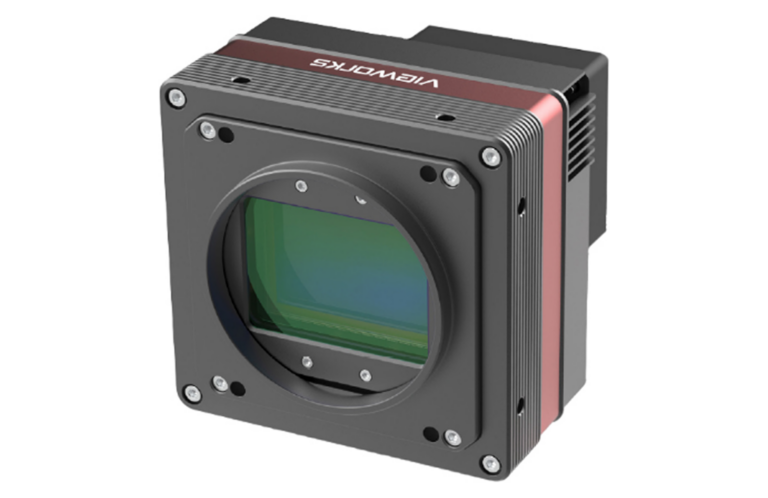
Vieworks has developed and manufactured the VP-288MX2 camera built off a sensor with an impressive native resolution of 288 megapixels. The sensor, designed by Syncron, was originally engineered for Samsung for flat panel inspection whose goal was to capture a single, highly detailed image, rather than several images stitched together.
While this camera is already impressive on its own, Vieworks has harnessed pixel shift technology and have just released a pixel shift version- the VNP-1152MX2, boasting effectively over a billion pixels.
But pixel shift not only greatly enhances the resolution of an image, it also revolutionizes colored imaging. Unlike conventional imaging, in pixel shift, the entire RGB spectrum is captured at each pixel.
Most camera sensors use a Bayer filter array, which is a mosaic of color filters (red, green, and blue) arranged in a specific pattern over the image sensor. As light hits the sensor, the Bayer filter only allows light of one wavelength, or color, to pass through onto each pixel, meaning the whole RGB spectrum doesn’t get captured. Because each pixel only gathers one color channel’s information directly, there’s a “gap” in the color data. An algorithm is used to “interpolate” these gaps. This interpolation process attempts to estimate the red and blue values for the green pixels and vice versa. While effective, interpolation introduces some loss of resolution because it’s essentially an educated guess based on surrounding pixels.
Pixel shift, however, addresses the pixel space gaps. When the sensor is being shifted, 4 images (in four shot mode) of the same pixel are captured. This allows for the collection of the full RGB color data at each pixel location, overcoming the limitations of the conventional Bayer filter. The images are then stitched together to create an extremely detailed image.
Pixel shift technology is very useful for today’s demanding markets such as semiconductor inspection, flat panel inspection, and film and document scanning.
Before, engineers had to rely on several lower resolution cameras each equipped with an expensive, high magnification lens to achieve their desired resolution. Each camera would take a picture of part of the object of interest. Then, using software, the images would be stitched together to get a complete view of the object. This can be expensive, complicated, and time consuming with slow throughput.
However, an ultra-high resolution camera equipped with pixel shift technology allows an image to be enlarged without relying as much on the lens for magnification. This gives developers the flexibility of choosing a lens with a larger field of view (FOV) to obtain more information per frame and improve inspection rates. By increasing the FOV, a developer captures the right amount of detail necessary for the application without having to stitch images from multiple, lower-resolution cameras.
Pixel shift redefines what’s possible in ultra-high resolution imaging. With the highest resolution pixel shift camera commercially available in the entire world, Vieworks empowers vision professionals to capture more detail, more data, and more clarity than ever before.
If you’re exploring ultra-high resolution imaging for your next project, visit our website or contact us directly as sales@visionsystech.com. And don’t forget- qualified customers can request a complimentary 30-day demo.